
WALK THE LINE – Antonio Colombo Gallery
by Ivan Quaroni
“I keep a close watch on this heart of mine,
I keep my eyes wide open all the time.”
(Johnny Cash, Walk the Line)
Riccardo Nannini’s painting grows out of close attention to what happens every day, from observing ordinary moments that he translates into clear, intelligible images with straightforward immediacy. Yet, within the apparent linearity of his pictorial style, there is always something uncertain slipping in — a detail that introduces a faint tension and prevents the scene from settling into stable order. It’s the way the artist turns lived experience into a fluid narrative, one open to the unexpected. Not everything in Nannini’s crisp images unfolds peacefully. Certain iconographic elements, for instance, insert something discordant into the story, transforming each scene into a small mystery.
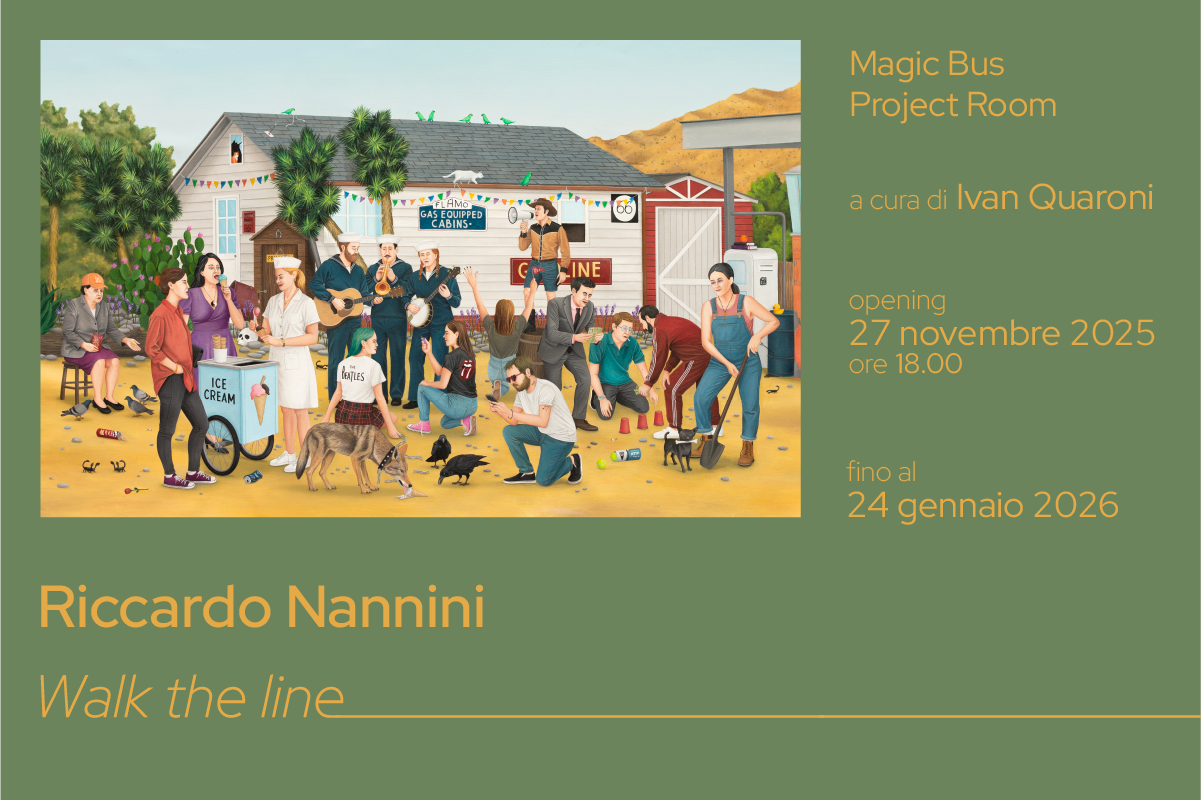
Nannini loves to paint suburban houses with their gardens and yards, desolate gas stations, even the low walls separating homes from slightly shabby streets — those boundaries that carve out private domestic space by cutting it off from the public sphere and the natural environment. These places seem lifted straight from a David Lynch or Tim Burton film, yet the artist shifts them into a comic-book or cartoon imaginary to tell real, or at least plausible, stories. They are motionless places, zones of waiting where the noise and bustle of real life are absent. Even when the scenes are crowded with figures, his paintings give the impression that the characters know they are being watched, as if they were performing life. Whether they’re partaking in an impromptu party, as in The Old Gas Station (2025), or posing in costume for a keepsake photo, as in The Carnival Party (2025), the men, women, and even the animals in Nannini’s work always have a strange stillness, like actors caught in a freeze-frame from a silent film.
And yet, Nannini uses a bright palette dominated by pinks, blues, and greens that lends his images a diffuse luminosity and a cheerful mood. So why all this silence? How do we explain this enigmatic, slightly dazed suspension in an evidently everyday setting? The artist chooses vivid colors, arranges figures, and distributes visual weights in such a way that this curious contrast makes each scene vibrate.
Much of Nannini’s visual language comes from his self-taught background. He built his craft through steady practice, direct study of the Italian figurative tradition, and a constant dialogue with contemporary visual culture. His experience in architecture and design gave him the tools to think visually and construct representation with rigorous structure. His move from Tuscany to Barcelona brought him into contact with Spanish culture; the Catalan city — with its sharp light, saturated colors, and lively streets — introduced a more direct and concrete dimension into his work. In that environment, shaped by the contrasts of urban life, Nannini developed an original way to portray daily experience, intertwining observation, memory, and lived reality.
Artistic influences were also crucial: American Pop Surrealism (filtered in Spain through artists like Sergio Mora and Joan Cornellà) and the tradition of Costumbrismo, the Iberian variant of 19th-century genre painting inspired by local customs and everyday life. All these currents converge in a measured language where lightness, irony, and attention to the social and cultural dynamics of the present coexist.
Despite the festive atmosphere and vivid colors, calm in Nannini’s painting is only apparent. A subtle unease runs through his narratives, revealing how civil life is built on a fragile balance between structuring and chaotic forces.
“Walking the line,” says Riccardo Nannini, “means living on the edge between harmony and danger, between lightness and disillusion.” The title Walk the Line, borrowed from a Johnny Cash song, reflects the artist’s intent to observe everyday life and its frequent slips into the irrational. From a stylistic standpoint, Nannini creates a kind of polarity between a controlled formal grammar and a dissonant iconographic content.
An example is Breakfast with Wolves (2025), which shows two divergent aspects of a quiet Sunday morning. The painting depicts a couple having breakfast in their backyard — a typical single-family suburban home — while outside, beyond the low wall separating their property from the sidewalk, two wild wolves roam the cracked pavement. Two worlds collide: the private realm, seemingly familiar and reassuring, and the public realm, chaotic and dangerous, where the wolves are quite literally at large.
In Tiger Queen (2024), in front of a similar enclosure wall behind which we glimpse yet another neat little house, a woman walks a tiger on a leash along a path littered with symbols of consumer society: a banknote, a fast-food meal, a watch, pills, a cigarette butt. Meanwhile, a man photographs the scene as though it were a fashion shoot. It is an unusual vision that normalizes the excessive and the bizarre, presenting them as something “cool.”
Welcome (2025) offers a more explicit scene: this time we are inside the fence, in the garden of a traditional wooden house. On the cobbled path leading to the entrance, the homeowner — holding a rifle — seems to be waiting for an unwelcome visitor. Around him are the signs of an orderly, regular life that reveal no hint of instability. But it is precisely here, in this apparent normality, that the boundary line cracks and the irrational threatens to erupt.
Ultimately, through his painting, Riccardo Nannini portrays normality as a perceptual threshold — a space where the orderly structure of the visible hides, just beneath the surface, the disintegrating forces of entropy.
PRESS & INTERVIEWS
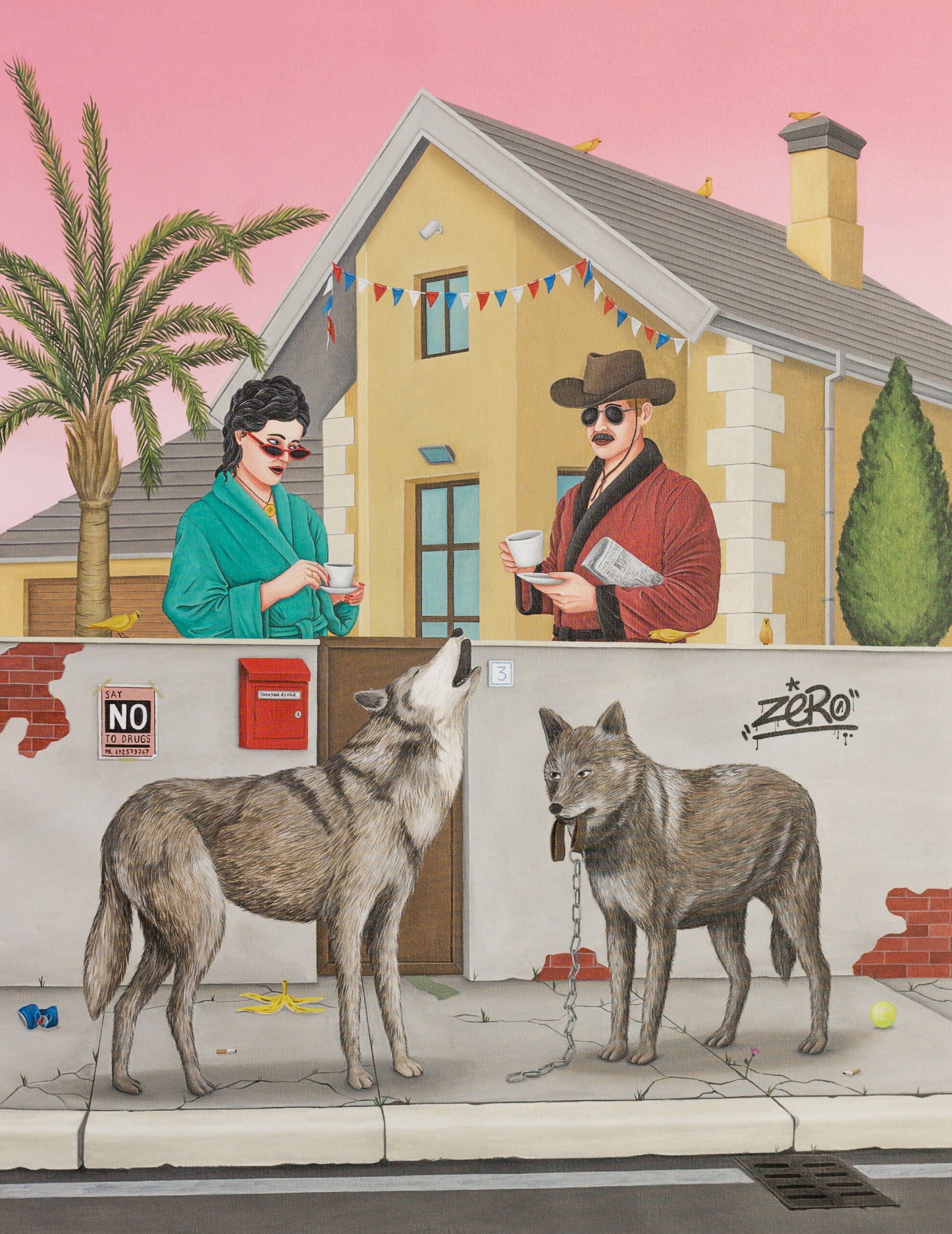
Breakfast with wolves – 2025
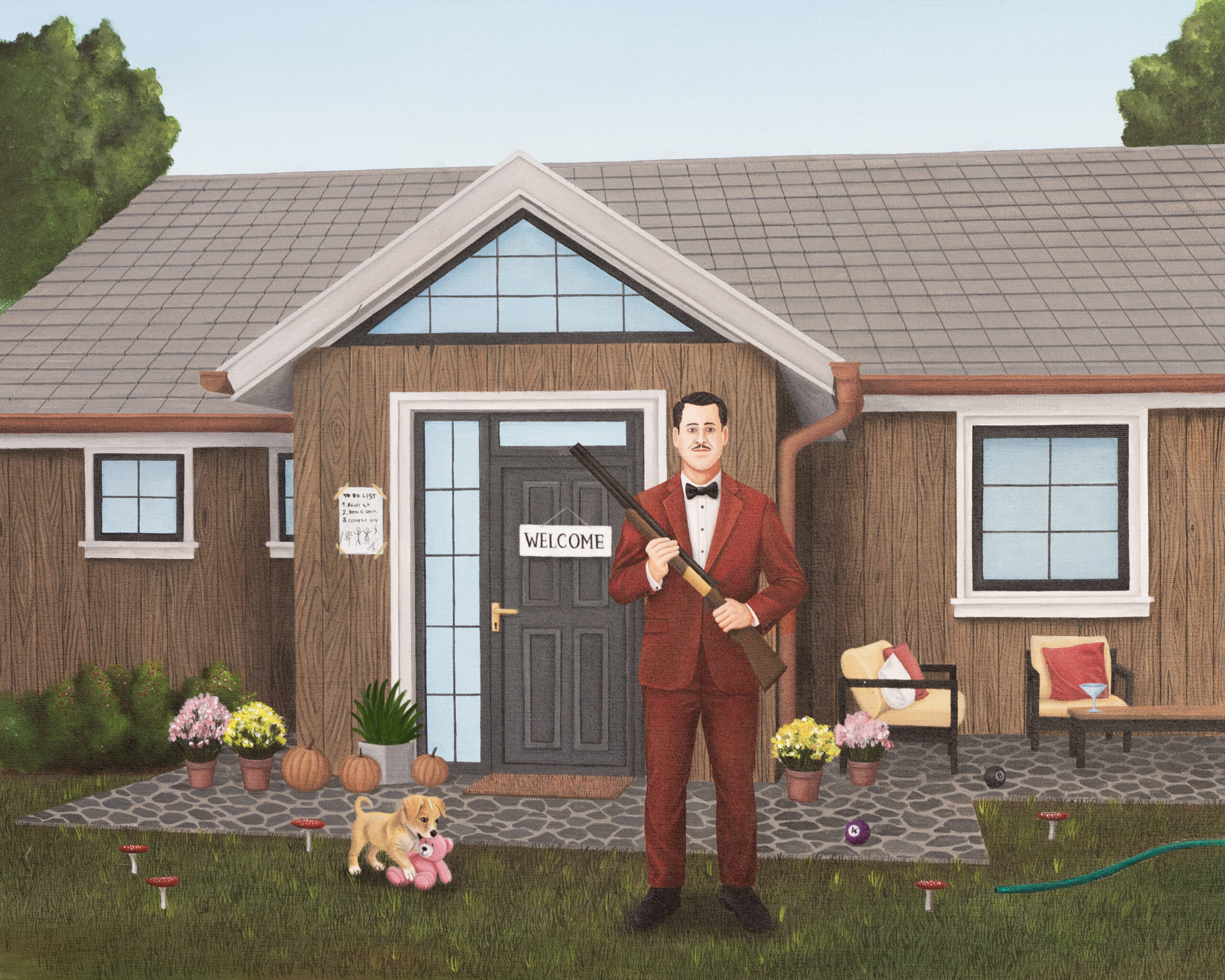
Welcome – 2025
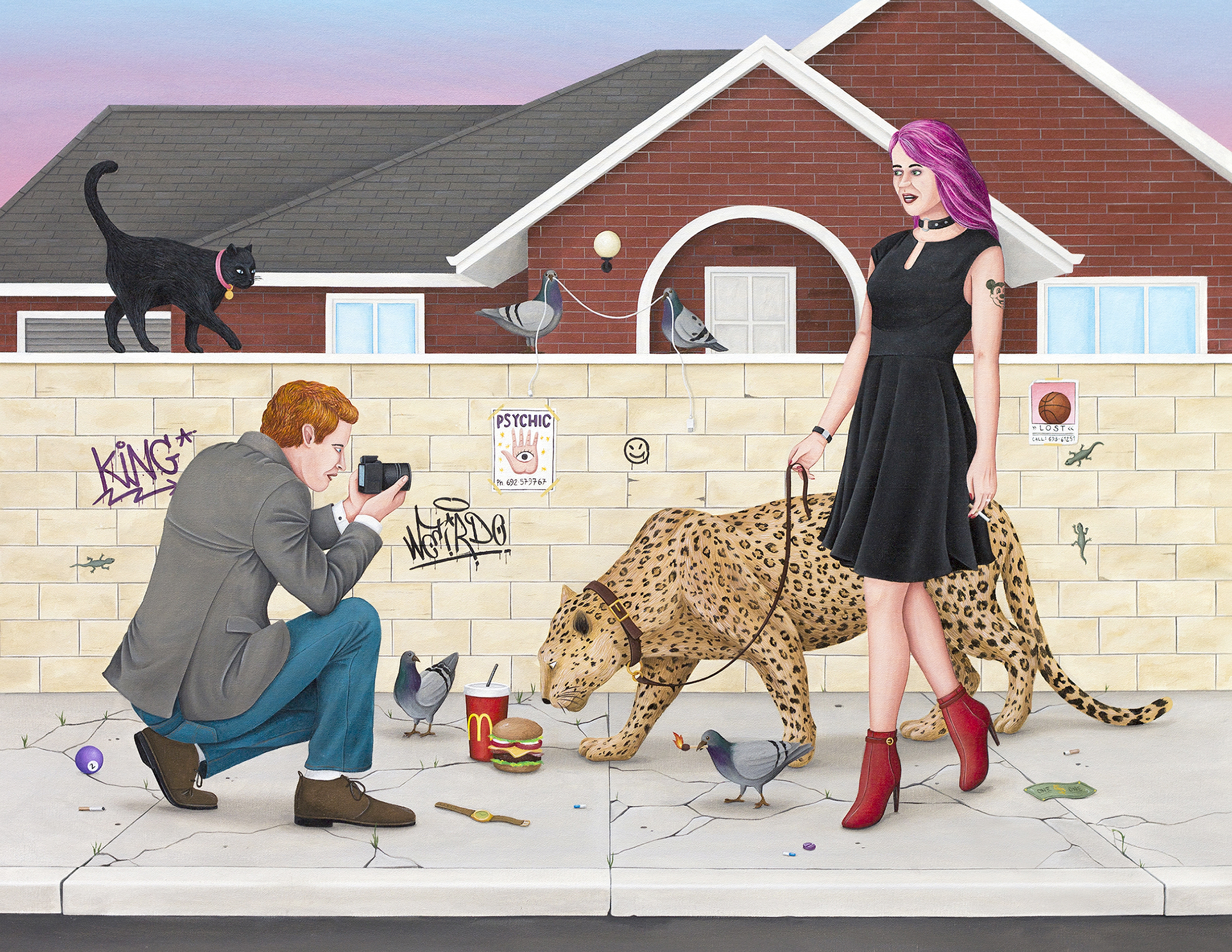
Tiger Queen – 2024
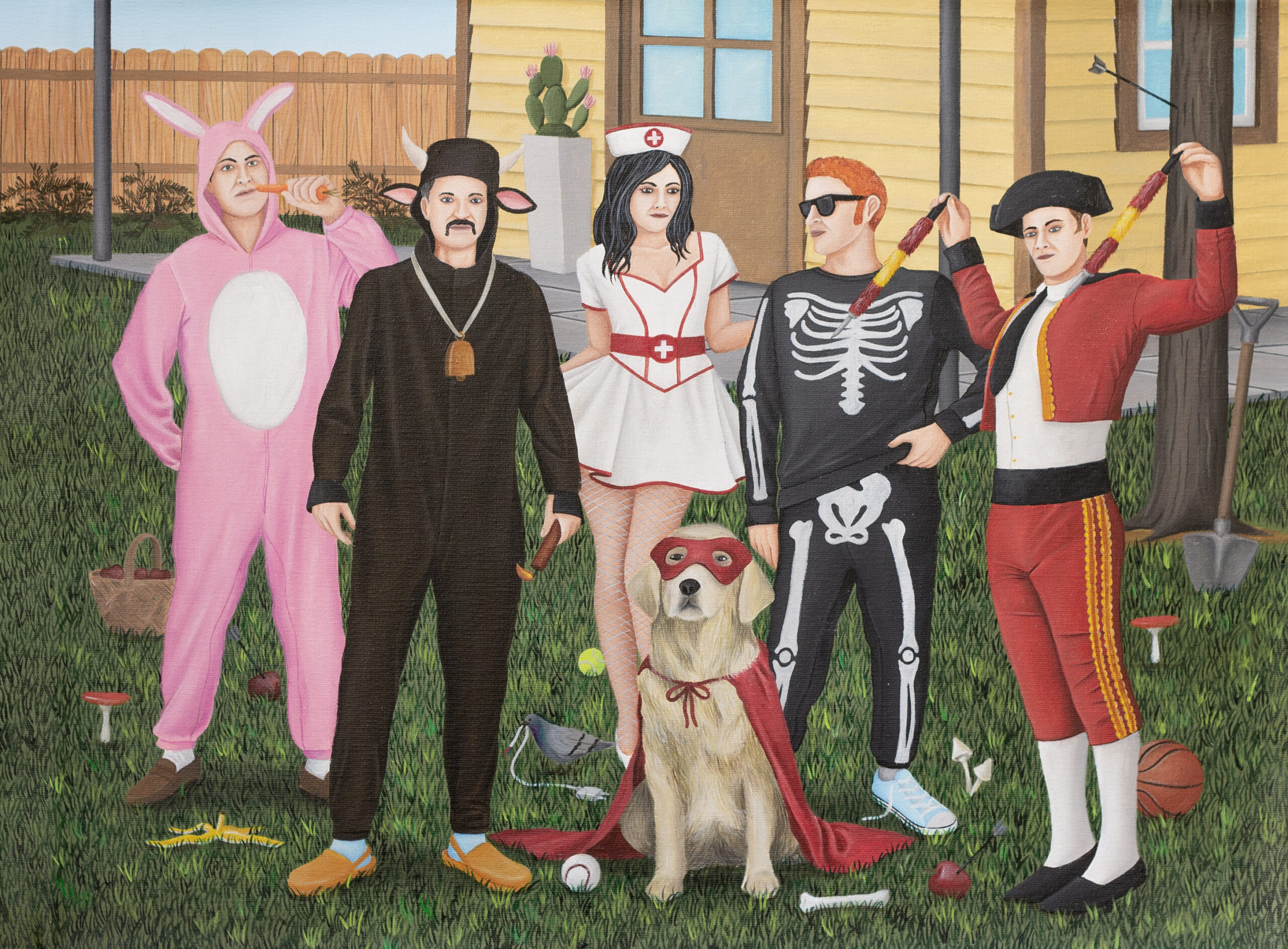
Carnival Party