
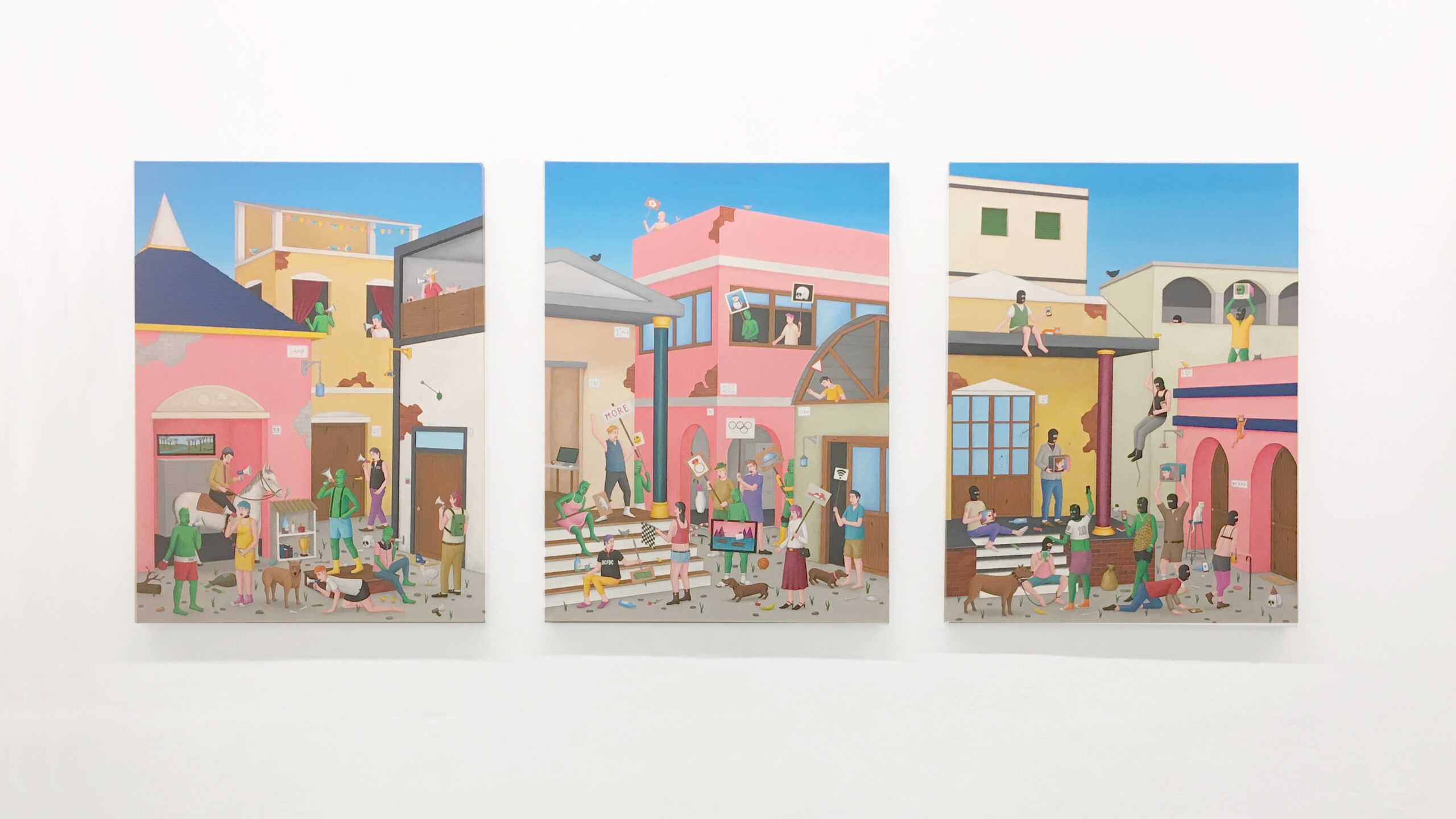
COSÌ FAN TUTTE – Galeria La Plataforma
Today, actions that are more or less ordinary—getting dressed, eating, moving around, exercising, socializing—no longer consist solely of those actions. Each of them now implies an act of expressing ourselves, of displaying our own singularity. We choose the clothes that best reflect our personality, the food that fits our consumption style, we move by car, bicycle, or public transport depending on our environmental concerns, we take care of our bodies according to certain beauty ideals, and we surround ourselves with people with whom we share existential goals.
It’s no surprise, then, that this growing desire to communicate who we are has triggered an explosion of channels dedicated to this purpose. Social media, video platforms, radio and television, blogs, podcasts, endless publications… a constant invitation to say something rooted in our intimate experience, to express ourselves for the sheer pleasure of doing so—whatever the message may be—simply because it is possible. What is said is no longer the point; it is not an ideological matter. Self-expression has become a mass aspiration.
This proliferation of information paradoxically turns the sender into their own primary recipient. Communicating for the sake of communicating, even if only for oneself, yet transmitted and amplified through a medium. Così fan tutte.
It’s true that we live in a time in which individualism, self-worship, the cult of image, and similar vanities have spread across all layers of society. For many, this is an unmistakable sign of decadence and loss of values; for others, such as the philosopher and sociologist Gilles Lipovetsky, it stems from a global transformation in how society functions.
Riccardo Nannini—keenly interested in behaviors and mass culture—reflects on these issues and presents his particular vision in the works that make up this new exhibition. As is typical in his practice, there is a contrast between message and tone: the naïf aesthetic, the loud colors, the drawing irregularities, and the constant dissonances significantly lighten the weight of the subject. No solemnity radiates from Nannini’s works; with a teasing attitude, he constructs sharp portrayals of narcissistic behaviors, building parallelisms where “any resemblance to reality is purely coincidental.”
To explore certain aspects of this phenomenon, he begins by focusing on how we construct our own image, understood as the primary vehicle for communicating the Self. Hence the four portraits in which each character—Jessica, Borjamari, Alex, and XY2999Z—tries to tell us who they are through clothing, makeup, accessories, tattoos, and even pets. A whole display of “singularity” like the ones we perform daily, which do not always manage to convey anything specific about us. Perhaps because that task has long been delegated to consumer objects which, through personalization, have refined their ability to define us—sometimes more effectively than we define ourselves.
In fact, the series of still lifes (Skull, Banana and Coke; Bourbon, Ball and Parcel; Teddy Bear, Globe and Money; and Honey, TV and T-Rex) helps us trace more concrete profiles, especially when juxtaposed with the portraits. Yet we should not forget the contradiction in this gesture: these are still objects designed for mass consumption.
In any case, for this search for identity to fulfill its self-realizing purpose, it must be revealed and affirmed in the public sphere; the narcissistic process is only completed once it crosses the boundary of the private. Nannini identifies this kind of narcissistic outing in some of its most widespread forms, represented in a series of three works. In I Want a Brand New Ego, we see characters who have chosen to cover their faces with balaclavas, showing them only through screens; after all, there is no image more “authentic” than the one we broadcast in the digital universe.
Meanwhile, in Your Inner Voice Deserves to Be Heard, a group of figures shout their opinions through megaphones all at once — but it is precisely this amplification of volume that renders every message unintelligible. And in I’d Like More of the Same, Please, the participants’ banners display as many demands as there are individuals: egoism and atomization that fail to articulate common causes — though the work also prompts us to consider how some demands gain more relevance than others.
Without a doubt, the rise of new technologies and the explosion of social media play a crucial role in this entire process, fostering the creation of microcosms in which individuals with similar concerns regroup among “identical” beings (narcissism can also be collective).
In Purple vs Yellow. No Matter the Reason of the Fight, we see a battlefield populated by two clearly distinguishable factions. The piece — inspired by images of the Battle of Antietam, described as the bloodiest combat of the American Civil War — appears to offer a disenchanted conclusion to this individualistic and narcissistic process which, in its most extreme form, contributes to the polarization of society.
However, once we look closely, we see both sides testing their strength in tennis matches or chess games, or facing each other playfully in a water fight; they even barbecue together or propose marriage. Here, confrontation is not violent. And that is the true conclusion: diverging opinions need not translate into rigid antagonism, but rather into constructive debate.
Generational clash or historical process, these issues continue to provoke different reactions decades after their early manifestations. Regardless of our position, it remains essential to preserve space for reflection, questioning everything that is handed to us. And if doing so feels tedious, Riccardo Nannini’s works offer a good place to start — fun is guaranteed.
PRESS & INTERVIEWS
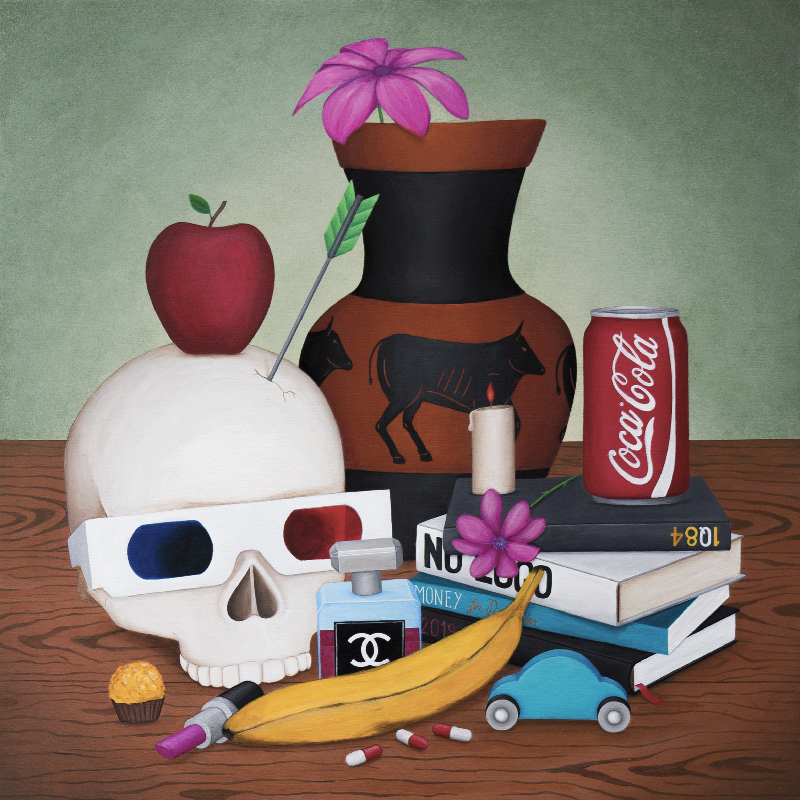
Skull, Banana & Coke – 2021
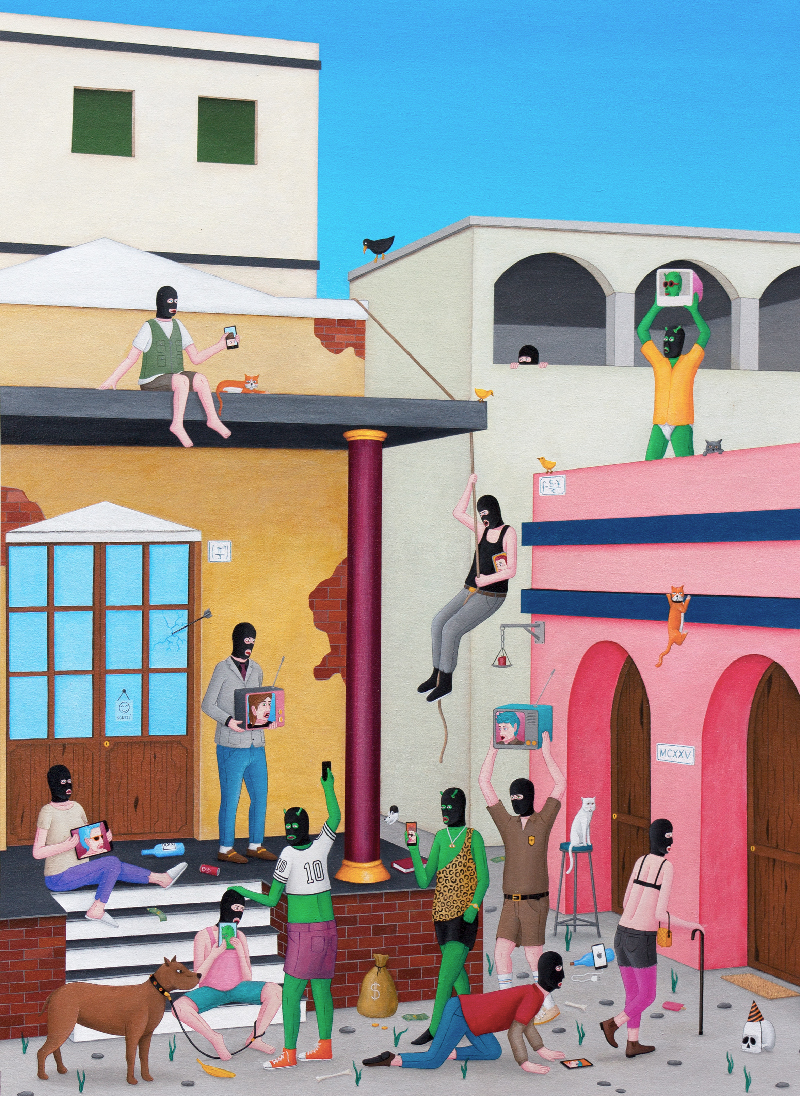
I want a brand new ego – 2021
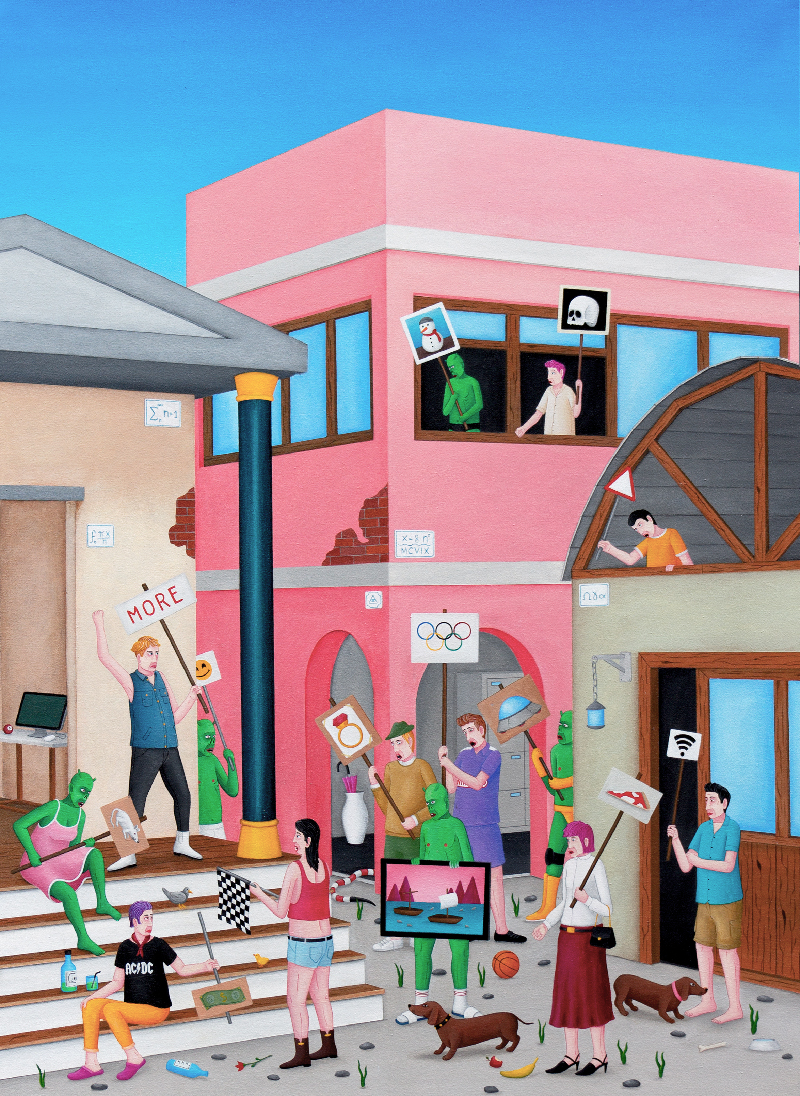
More of the same, please! – 2021